Storytelling and Exhibition Inspiration
You may have already some ideas or content that you want to work on and develop into an exhibition or as part of story telling for your own use cases. We will look to support you in developing those ideas during this workshop.
However, we thought it might be helpful to list a few examples of some great digital exhibition or story telling examples that we have come across, which might provide some ideas or inspiration for your work today or in the future. Enjoy!
Exhibitions at TU Delft and University of Leeds
Section titled “Exhibitions at TU Delft and University of Leeds”As we will discuss during the workshop today, the TU Delft team have been pivotal in the iterative development of the tools that we will demonstrate and use for exhibition building activities. The tools have iteratively developed alongside their exhibition development, and the following are a selection of a few digital exhibitions they have curated alongside their physical counterparts.
- https://heritage.tudelft.nl/en/exhibitions/novieten
- https://heritage.tudelft.nl/en/exhibitions/voices-of-wis
- https://heritage.tudelft.nl/en/exhibitions/gen-ai
For more examples, please visit TU Delft Library’s Academic Heritage website
Using the same toolset, a University of Leeds specific template was created to enable them to publish an exhibition last summer to coincide with the 2025 IIIF Conference that was hosted at the University. This provides a nice example of how the same viewer can display content in similar but distinct ways to suit the exhibition content, and curation approach.
Example exhibitions using Manifest Editor and Exhibition Viewer
Section titled “Example exhibitions using Manifest Editor and Exhibition Viewer”These IIIF Manifests were originally created and developed in collaboration with the Victoria & Albert Museum in London, alonside some of original development of the Manifest Editor and an exhibition display that the V&A team developed online back in 2017. These Manifests used annotations to create the additional storytelling elements, with the layout designed specifically for the custom viewing display created then on their website.
What these examples demonstrate is that the IIIF content continues to be interoperable and display within newer iterations of the tools; and whilst the layout and display hasn’t been specifically optimised, the story telling narratives continue to work effectively in the Exhibition Viewer, as well as in many existing IIIF Viewers.
- https://preview.exhibitionviewer.org/preview/scroll?manifest=https://stephenwf.github.io/ocean-liners.json&minimal=false&floating=true
- https://preview.exhibitionviewer.org/preview/scroll?manifest=https://iiif.vam.ac.uk/collections/O134051/manifest.json&minimal=false&floating=true
The following two examples demonstrate how a IIIF Manifest can be curated using the Manifest Editor and the Exhibition editing tools.
The first example has a single Medieval Manuscript page, with a series of annotations in the tour steps. Use the navigation icons or click the ‘Play’ button on the exhibition controls at the bottom of the page.
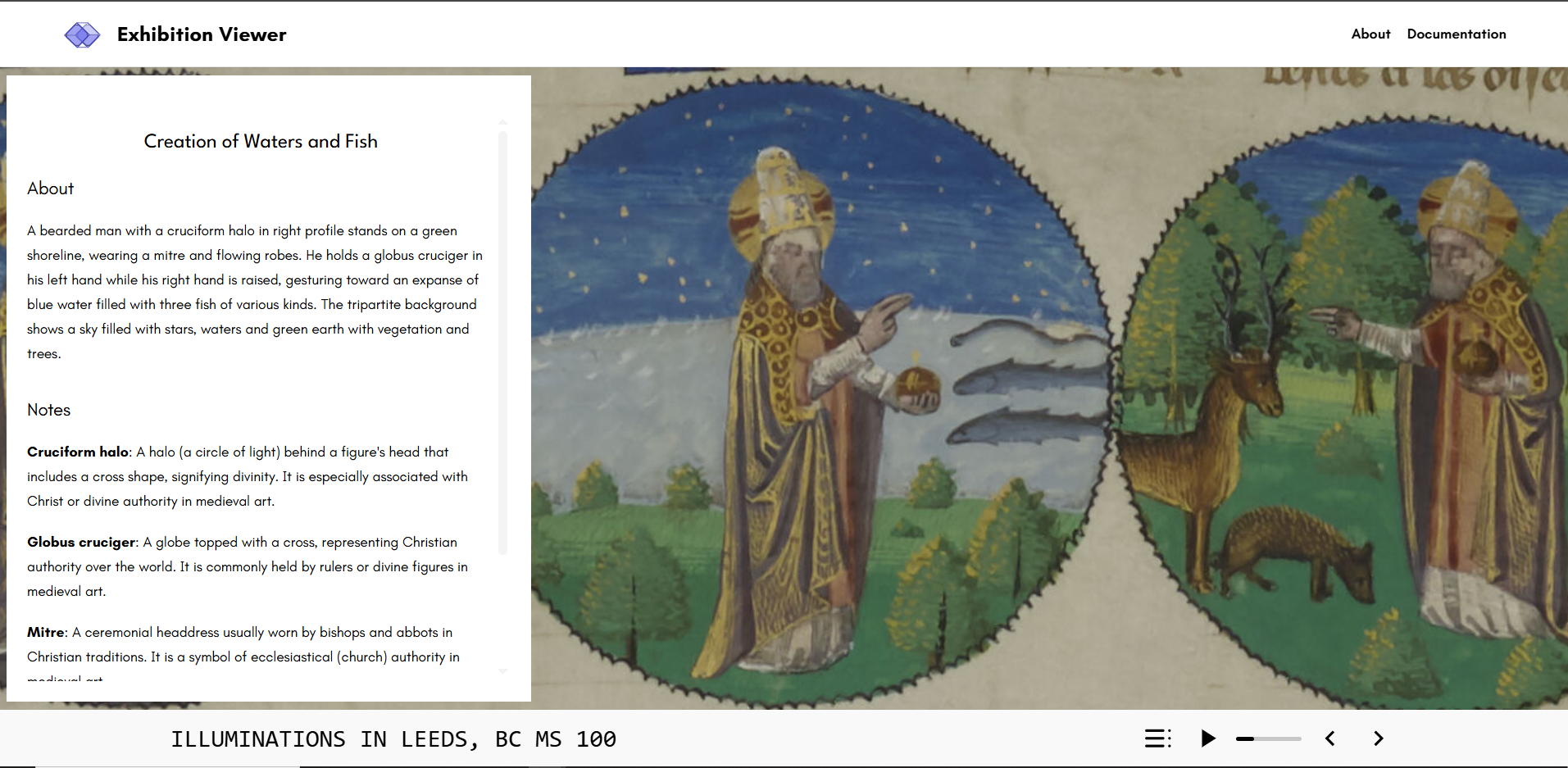
Click to view the example Exhibition: Illuminations (sample)
The second example focusses on the same Medieval Manuscript, but it contains a number of pages from the manuscript with a series of annotations in the tour steps. Use the navigation icons or click the ‘Play’ button on the exhibition controls at the bottom of the page.
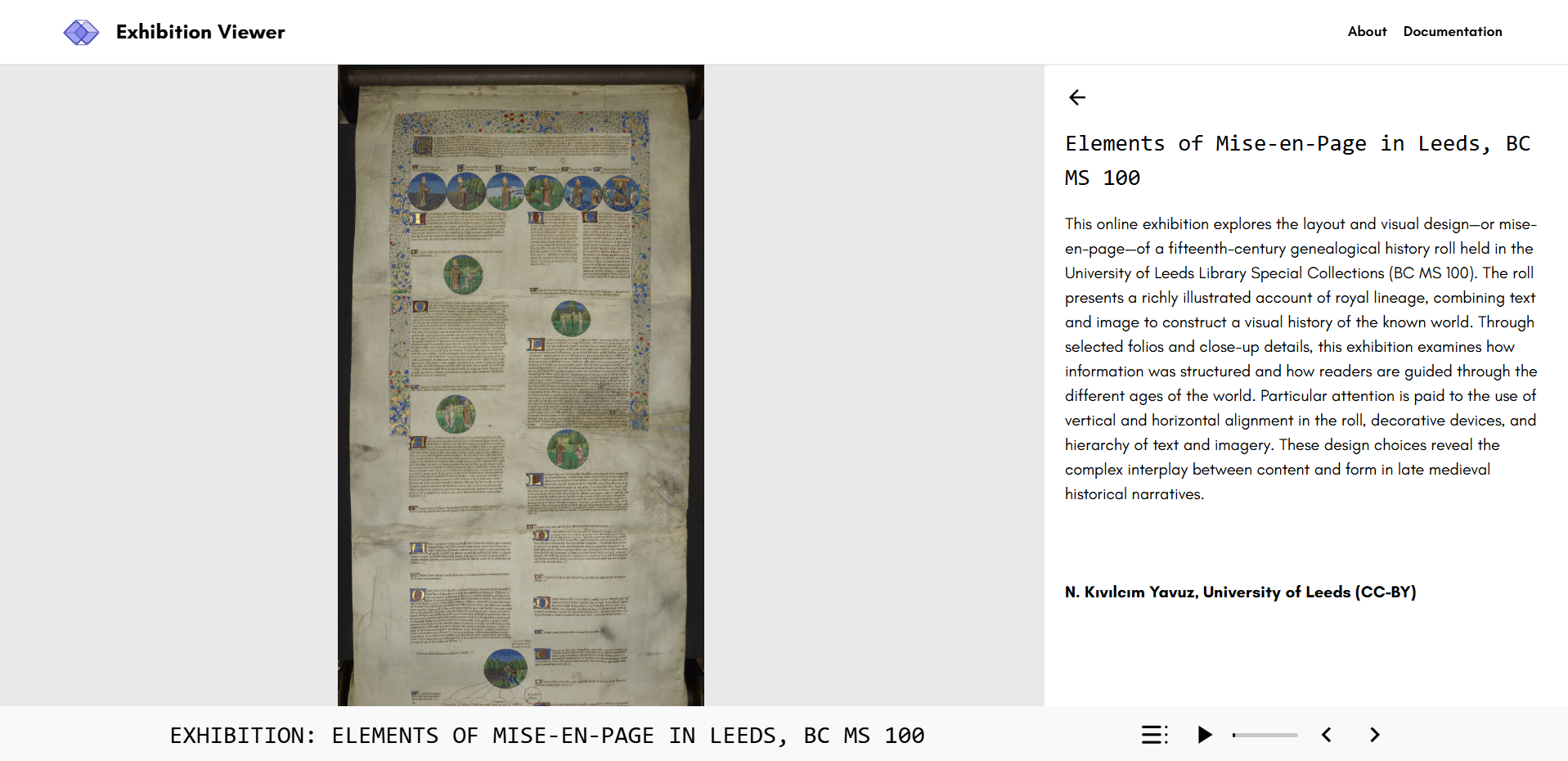
Click to view the example Exhibition: Elements of Mise-en-Page (sample)
Other examples featuring both IIIF and non-IIIF content
Section titled “Other examples featuring both IIIF and non-IIIF content”A series of Stories from the Rijksmuseum, in Amsterdam - including for example: https://www.rijksmuseum.nl/en/stories/story/10-things-about-johannes-vermeer
The State Library of New South Wales’ Gather project: https://gather.sl.nsw.gov.au/
The National Museum of African American History & Culture’s “The Searchable Museum” has a great variety of engaging digital exhibitions including:
- https://www.searchablemuseum.com/era-of-segregation/#defending-freedom-in-the-era-of-segregation-18651968
- https://www.searchablemuseum.com/hip-hop-origins/
An innovative presentation of maps and history, this digital exhibition (counterpart of a physical exhibition) Becoming Boston: Eight Moments in the Geography of a Changing City presents an introduction to the historical and present-day story of Boston. See https://www.leventhalmap.org/digital-exhibitions/becoming-boston/
This digitised magazine/publication was created alongside an exhibition held last year (February 19 to June 8, 2025), at the Milberg Gallery, Firestone Library, Princeton University. You can view the Manifest (https://figgy.princeton.edu/concern/scanned_resources/4e2b0909-ce4b-43ad-8a75-85ecfb61b8c1/manifest). It presents a series of works from Princeton’s special collections including Graphic Arts, Manuscripts, Rare Books and Numismatics.
The University of St. Andrews and Mnemoscene have developed Exhibit.so using the Universal Viewer, which is used to create exhibitions and interactive experiences using digitised collections. There are lots of interesting examples of these exhibitions including: https://www.exhibit.so/exhibits/A9v7lFvtD3hct3WbK8cf and https://www.exhibit.so/exhibits/q9gjkwTw7HBIgO9EVAOJ
This Mirador based exhibition features a variety of differing types of content and systems - see https://www.sciencestories.io/Q450317?moment=0.
Cogapps’ Storiiies exhibition viewer is another IIIF enabled tool, which has been used to create interesting exhibitions and guided tours. See an example from the Shakespeare in the Royal Collection online exhibition.